Via Scoop.it – Movin’ Ahead
‘Bring Your Own Mac’ Program Provides New Insight, Learning for ITPutting Apple MacBooks to work behind the corporate firewall is something many small Silicon Valley startups may have been doing for years, but it may be less likely inside larger,…
Show original

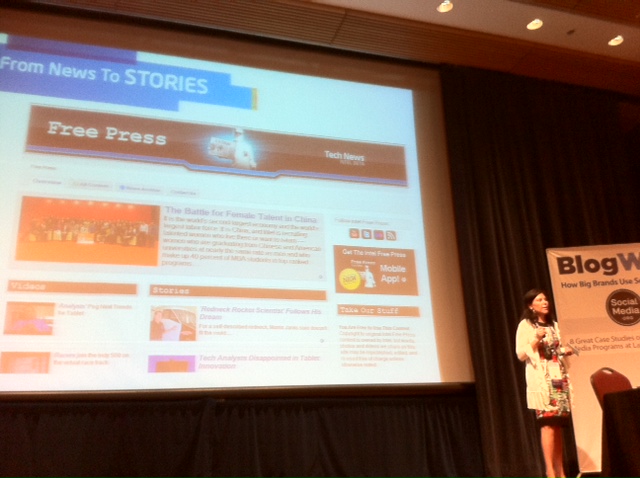
Video: Sean Maloney on Moving Intel Faster, Doing More in China
Via Scoop.it – Intel Free Press
Just prior to his keynote at Computex 2011 in Taipei, Taiwan, newly named Chairman of Intel China Sean Maloney talks with Intel Free Press leading Intel through a rapidly evolving mobile computing industry.
Show original

I shot and edited this interview inside Intel headquarters, and although my production skills were lacking (poor audio, lighting…) I was beside myself as Maloney focused and delivered answers to some tough questions.
I later tuned in for his keynote, which can be seen here or highlights below, and was truly in awe at his expresiveness, passion, charm and twinkle that often shined from his eyes.
He has been so devoted to Intel for decades, and that determination has helped his recovery from a severe stroke that pulled him out of work last year. He lost his ability to speak, but worked with experts to retain his brain and when I was shooting this video and watching his Computed keynote, I couldn’t help but keep smiling. Maloney is a leader who leads by example, by doing and participating.
User Experience Takes Center Stage at TechFest
Via Scoop.it – Intel Free Press
PORTLAND, Ore.—There were more 1,000 of them from all over the world; Intel researchers and scientists chatting and sharing knowledge and information about transistors, systems, software, validation, voltage, augmented reality, power—and perhaps…
Show original

Tech Savvy Tikes

Every generation gets the spoils of new technologies that their parents were introduced to, and often the new generation seems to have a natural inclination for using new things, whether it was the advent of the automobile, to TV, telephones, computers and today with mobile gadgets like smartphones and tablets.
What I noticed was that many parents were sharing their “precious” and pricy touch screen iPhones and iPads. I used to share my blackberry with my two kids when they were toddlers and later gave them classmate PCs of their own. Even then, I noticed they wanted to mimack me but they were genuinely curious and not affraid to figure out how it worked. I delight at this, not for technology’s sake, but for the eveidence that most people are naturally curious and willing to try.
This sparked an ideas to write an article that my editor dubbed Touch Generation. Rather than talk about technology as a whole — how parents are taking more photos and videos of their kids, creating an online dossie for their kids at an early age — we focused on the ease with which young children took to touchscreen devices. I spoke with a handful of recent parents, people who I saw regularly sharing photos of their children on Facebook and on Twitter.
The issue of screen time is important, and one that most parents seem aware of when sharing their devices with their children. The best common sense advice from most people I spoke with was to “share” this screen time or collaborate with children when they are using technology…and to not spend too much time in front of the screen, but enough to get invovled and explore together.
The story sparked some conversation on Facebook and a few blog posts have been created since we released the story on Intel Free Press, but this topic has been bubbling and bouncing around for a few years now. It’s been interesting to read experiences others are having when they share their touchscreen tech with their toddlers, and how parents are coping with good and bad behaviors as how they feel about any potential harm being caused by allowing young children to use technology.
I’d say — and I practice — don’t make technology a big deal. Show that it’s helpful and useful but that direct contact with people and physical activities are critically important to our bodies and minds. In fact, the rise of “social computing” has best surved me with their is an equal or bigger “social” interaction and relationship that happens in real life — sharing lunch, meeting at events…
I will keep adding her any related stories that I find, and I encourage you to share your experiences parenting the Touch Generation.
Story by Ali Heriyanto of Chip Chick: Are We Raising the Touch Generation
Today’s children are the “Touch Generation” by Ubergizmo
Sascha Pallenberg of NetbookNews.com shared with me video of a panel he lead a while ago where Carmen Villadar of What’s Up Andriod, who talks about how future generations are certainly growing up in a world where they’ll be using touch technologies their whole life (about 19 minutes in).
Repost of Chip Chick and Ubergizmo stories by:
Computer Born of Greek Democracy
According to archaeologists, the birth of the world’s first computer was much closer to the dawn of democracy than to the digital age.
Below is a link to a story I wrote for Intel Free Press looking at some of what’s known about the Antikythera Mechanism, discovered by sponge divers in 1900. It dates to the around 100 BCE, according to scientists studying it over the centuries.
The story was inspired by my archaeologists wife, and features a quote from her UC Berkeley friend and scientist Leonidas Petrakis, a former director at the Department of Energy’s Brookhaven National Laboratory, who recently wrote an article about the device for National Herald, a weekly publication for Greek-American news and culture.

 Movin' Ahead